Dashboard skins, door panels, instrument surfaces, and seat coverings demand more from PVC compounds than basic flexibility. The material must balance softness, appearance, durability, light stability, and interior-air requirements while remaining processable at industrial scale.
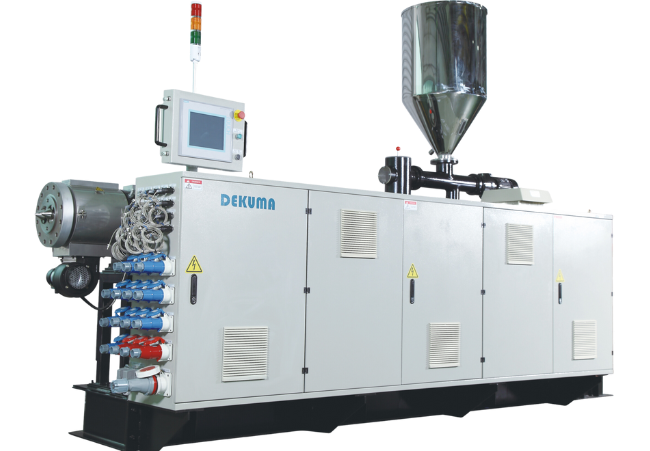
A twin screw extruder provides controlled mixing and thermal processing for formulations containing PVC resin, plasticisers, stabilisers, pigments, and other functional additives. DEKUMA develops extrusion equipment for PVC processing and offers twin-screw configurations intended for applications where formulation consistency is critical.
Formulation Begins with Interior Performance
Automotive interior PVC is formulated around its final use rather than around resin content alone. Dashboard and door-panel skins may require a particular hardness and tactile response, while seat-covering materials need sufficient flexibility to withstand repeated contact and deformation. Plasticiser selection consequently affects both processing behavior and the finished material’s mechanical characteristics.
Light stability becomes another consideration when interior surfaces are exposed to sunlight through vehicle glazing. Pigments, stabilisers, and the base formulation must work together to limit undesirable changes in color or surface appearance during service. The required formulation depends on the vehicle program, exposure conditions, color, and specified test methods.
Low-fogging performance addresses a different concern. Volatile or semi-volatile substances released from interior materials can condense on cooler glass surfaces, affecting optical clarity. Automotive specifications may consequently include fogging evaluations alongside odor, emissions, and material aging tests. A formulation that performs well mechanically still requires separate assessment against these interior-environment requirements.
How Twin-Screw Processing Shapes Compound Quality
A twin screw extruder machine is suited to compounding because intermeshing screw elements can provide distributive and dispersive mixing within a controlled processing zone. Feed sequence, screw configuration, residence time, temperature profile, and rotational speed all influence how effectively the formulation becomes a homogeneous melt.
Plasticiser incorporation requires particular attention because poor distribution can create variations in softness and processing behavior. Additives also need to disperse sufficiently throughout the PVC matrix. Excessive shear or unsuitable thermal conditions, however, can create unnecessary degradation risks, so the process window must be established around the actual formulation rather than copied from another compound.
Temperature management extends beyond the barrel setpoints. Material temperature, shear-generated heat, residence time, and cooling capacity interact throughout the extrusion process. Stable melt conditions help reduce batch-to-batch variation, which becomes especially important when the compound is later converted into visible interior surfaces where small differences in color, gloss, or texture can become noticeable.
Verifying PVC Compound for Automotive Approval
Laboratory testing provides the bridge between formulation development and automotive material approval. Hardness, tensile properties, elongation, abrasion resistance, heat aging, and dimensional behavior can characterize the basic mechanical profile, while light-exposure testing examines resistance to changes caused by prolonged illumination.
Interior applications require additional attention to emissions-related properties. Fogging tests can assess condensable substances released from a material under specified conditions, while VOC-related methods may evaluate volatile organic compounds. Odor testing can also form part of an automotive manufacturer’s material specification. The exact test combination varies by vehicle manufacturer, material location, and program requirements.
Color and surface evaluation should not be separated from the compound itself. Pigment dispersion, thermal history, and additive distribution can influence the appearance of the final product. Production samples should consequently be evaluated using defined reference conditions and repeatable measurement procedures rather than relying only on visual comparison.
Linking Compounding Parameters to Final Use
The relationship between extrusion conditions and material performance becomes clearer when quality data are tracked against production parameters. Changes in feed rate, screw speed, melt temperature, or formulation ratios can be correlated with laboratory results, helping processors identify which variables have the greatest effect on a particular compound.
DEKUMA’s DKM-EII series includes conical twin-screw extruders designed for PVC processing, with the DKM-EII51/105 listed at a maximum output of 100–120 kg/h, while the DKM-EII65/132 is listed at 280–350 kg/h. The series is intended for PVC-U, PVC-M, and PVC-C pipe production, so automotive interior compounding would require an application-specific configuration and validation rather than assuming that a pipe-extrusion setup directly represents an interior-compound process.
Downstream conversion also affects the final assessment. A compound may pass pellet-level tests but behave differently during calendering, coating, molding, or skin formation. Automotive qualification is consequently better understood as a chain of material, processing, conversion, and final-part evaluations instead of a single extrusion-stage inspection.
Conclusion
Automotive interior PVC compound development involves several performance requirements that can interact in complicated ways. Plasticiser systems influence flexibility, stabilisers and pigments contribute to appearance durability, while low-fogging and emissions requirements address the cabin environment. Processing conditions must preserve the intended formulation characteristics without introducing avoidable variation.
The extrusion stage provides a controlled environment in which those formulation variables can be mixed and thermally processed, but material approval ultimately depends on the finished compound and component meeting the applicable test criteria. DEKUMA supplies DKM-EII twin-screw extrusion technology for PVC processing, providing a configurable equipment platform while leaving the final automotive specification to the compound formulation, downstream process, and vehicle manufacturer’s qualification requirements.