Solar farms are producing electricity at increasingly large scales, but solar generation does not always coincide with electricity demand. Battery storage can absorb surplus generation during high-output periods and discharge it when solar production declines. In 2026, selecting the right energy container requires more than comparing nominal capacity. Developers should consider power, duration, efficiency, safety, thermal management, site conditions, and long-term economics.
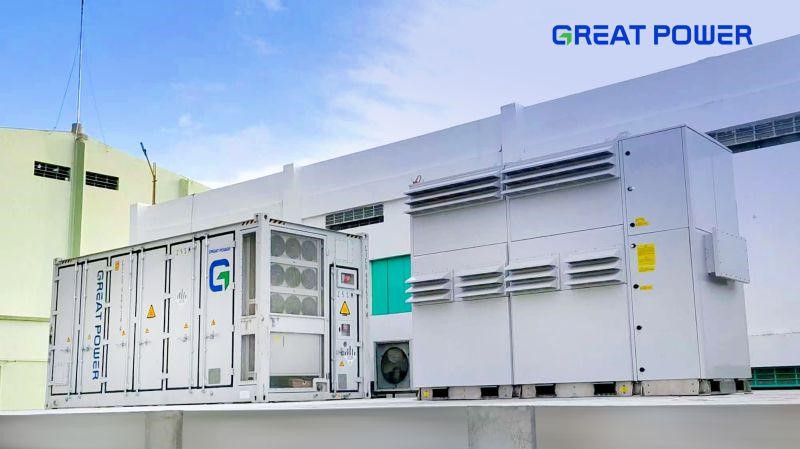
Why Solar Farms Need Large-Scale Battery Storage?
Solar generation typically reaches its highest output during daylight hours, while electricity demand can remain elevated after sunset. This mismatch can create periods when renewable electricity is available but cannot be used immediately.
An energy container can store excess solar generation and dispatch it later according to project requirements. Depending on the system configuration, storage can support energy shifting, reduce curtailment, manage output fluctuations, and provide grid services.
What Makes a Good Solar Storage Container?
The best system depends on the solar farm’s generation profile and grid connection requirements. Developers should begin by identifying the amount of excess solar electricity that needs to be stored and the period over which it should be discharged.
Power and energy capacity should be evaluated separately. Energy capacity determines how much electricity the system can store, while power capacity determines how quickly it can charge or discharge. A solar farm requiring rapid output control may therefore need a different configuration from one primarily designed for evening energy shifting.
Operating cycles also matter. Projects with daily charge and discharge schedules should pay close attention to battery degradation, round-trip efficiency, thermal management, and warranty conditions.
Max 6250 for High-Capacity Solar Projects
For large solar installations where maximizing stored energy within a defined footprint is important, the Max 6250 is one option in the large-scale portfolio. It uses self-developed Ultra 588Ah battery cells and a high-safety liquid-cooled PACK. The system also incorporates a six-level safety protection system for liquid-cooled energy storage cabinets.
This configuration can be considered for solar farms seeking high-capacity containerized storage without treating the battery container as an isolated component. The thermal architecture, protection design, and system integration should be evaluated alongside the solar plant’s operating profile.
Developers should also examine the complete system footprint, installation arrangement, access requirements, and grid interface before determining whether this configuration is suitable for a specific site.
Max 5000 for Balanced Efficiency and Integration
The Max 5000 is another containerized option for solar applications. The manufacturer’s published information specifies battery cell efficiency of at least 96% and DC-side round-trip efficiency of 96% at 0.25P and 95% at 0.5P.
Its integrated 20-foot container design can simplify deployment, while the system provides IP55 protection overall, IP67 protection for the Battery Pack, IP54 protection for the high-voltage box, and IPX5 protection for the electrical compartment. It is also listed as compliant with UL9540A and NFPA855.
The manufacturer specifically identifies photovoltaic and wind power generation, as well as regions with significant peak-valley price differences or large load fluctuations, among its application scenarios.
Max 3440 for Flexible Solar Integration
Not every solar project needs the same storage configuration. The Max 3440 provides another option within the large-scale range and is designed around an integrated system architecture.
For solar developers, integration capabilities can be particularly important when storage must communicate with plant controls, SCADA, or an energy management system. The manufacturer states that the Max 3440 supports integration with third-party SCADA and cloud-based EMS platforms.
This can help project teams evaluate storage as part of the wider photovoltaic power plant rather than as a standalone battery asset.
Liquid Cooling Matters for Solar Farm Environments
Solar farms can operate in demanding outdoor environments, including areas with high ambient temperatures and significant solar exposure. Thermal management should therefore be considered during system selection rather than treated as a secondary specification.
Liquid-cooled systems can provide controlled thermal conditions across battery components when properly designed and operated. The manufacturer’s LiqPack-280Ah 1P48S and LiqPack-280Ah 1P52S are liquid-cooled packs designed for container and cabinet energy storage systems. The product information states that thermal insulation between cells helps prevent heat diffusion and that the temperature difference can be maintained within 2°C under specified conditions.
Actual project performance will depend on the complete system, operating conditions, and installation environment.
Consider Safety at the System Level
A solar farm storage project should evaluate safety beyond the battery chemistry itself. Important considerations include electrical protection, thermal management, enclosure protection, fire detection and suppression, monitoring, emergency shutdown, and applicable certifications.
The Max 5000 provides several defined protection levels across its enclosure and electrical sections, while its published safety information includes UL9540A and NFPA855 compliance.
Project developers should confirm that the selected configuration satisfies local codes, grid requirements, insurance conditions, and the authority having jurisdiction. Certification requirements can vary by market and project design.
Evaluate Total Project Economics
The purchase price of a container is only one part of the investment. Developers should consider installation, PCS integration, auxiliary consumption, maintenance, degradation, replacement requirements, efficiency losses, and expected operating life.
For industrial battery storage projects, a system with higher initial cost may deliver better lifecycle economics if it provides greater usable energy, better efficiency, stronger thermal management, or longer service performance.
Financial modeling should use realistic operating assumptions. These should include charge and discharge rates, depth of discharge, annual cycles, ambient temperature, degradation, electricity prices, and revenue from grid or energy-management services.
Why Great Power Fits 2026 Solar Storage Projects?
Great Power’s current portfolio spans energy storage cells, packs, racks, cabinets, and containerized systems, giving developers options across different system scales. Great Power states that its storage products are deployed in more than 50 countries and areas and that more than 300,000 sets have been installed.
Its large-scale range includes Max 6250, Max 5000, and Max 3440 systems, with configurations addressing different requirements for capacity, efficiency, safety, and integration. The portfolio is therefore relevant to solar developers evaluating storage according to plant size, operating strategy, and site constraints rather than relying on a single standard configuration.